













 1.3% Up from past week


















FAQ's
Frequently Asked Questions
The cost of ERPNext implementation in Dubai depends on how big your company is and what you need from your ERP system. Wahni puts together ERPNext pricing that makes sense for businesses in the UAE, whether you're a startup or running a bigger operation.
Usually anywhere from 2 to 8 weeks. If you need basic features, it's faster to implement ERPNext in Dubai. Do you have lots of custom requirements or tons of old data to migrate? Then it'll take a bit longer. ERPNext implementation in the UAE timing really comes down to what your business needs.
Yes. Our ERPNext setup in Dubai is built to handle UAE VAT rules correctly. We configure everything based on what the FTA requires, so you're covered on the compliance side.
Yes, we do. Wahni is an ERPNext consultancy in Dubai, which means we train your people properly and we're here to help after you go live. No one gets left figuring things out alone.
We've set up ERPNext in the UAE for trading firms, factories, construction companies, shops, FMCG distributors, and service businesses. At Wahni IT Solutions, we configure ERPNext to match how your particular industry operates in Dubai and the rest of the UAE.
We're certified ERPNext partner in Dubai, and we've done this before many times. Wahni IT Solutions takes care of the whole thing: ERPNext consulting, customization, getting your VAT right for the FTA, training, and support after launch. We know the UAE market and we're based in Dubai.
Yes. The UAE's FTA e-invoicing mandate requires businesses to issue invoices through the Peppol network in PINT AE XML format. We set up ERPNext to generate FTA-compliant e-invoices automatically and connect it to an accredited service provider (ASP). Your team issues invoices the same way they always have. We handle the full setup, ASP integration, and testing as part of our standard implementation service.
Yes. The UAE Corporate Tax applies to businesses with taxable income above AED 375,000. As part of your ERPNext setup, we configure your chart of accounts, financial reporting structure, and tax ledgers to be Corporate Tax-ready. Your financial statements are structured correctly for CT filing from day one, and your finance team can generate the reports needed for Corporate Tax submissions without any manual rework after go-live.
Yes. We set up ERPNext to generate WPS-compliant salary transfer files directly from your payroll run. Your HR team processes salaries inside ERPNext and exports the WPS file to submit to your bank. This removes manual spreadsheet payroll entirely and eliminates the compliance risk of incorrect or late WPS submissions.
Yes. ERPNext supports Arabic with a full right-to-left layout. We configure your invoices, delivery notes, purchase orders, and other key documents to print in bilingual Arabic-English format. This is part of our standard UAE setup. You do not need a separate plugin or additional development. Your customers receive properly formatted bilingual documents from the day you go live.
Yes. We have migrated UAE businesses from SAP Business One, Odoo, Microsoft Dynamics, Tally, Tally Prime, QuickBooks, Zoho Books, and custom legacy systems to ERPNext. The migration covers your historical transactions, opening balances, customer and supplier records, inventory data, and open documents such as unpaid invoices and active purchase orders. Data migration is included in our standard implementation scope and handled by our technical team. Your operations continue normally throughout the process.
Yes. Wahni IT Solutions serves businesses across all seven UAE emirates, including Dubai, Abu Dhabi, Sharjah, Ajman, Ras Al Khaimah, Fujairah, and Umm Al Quwain. We also work with companies in UAE free zones, including DMCC, JAFZA, DIFC, and SAIF Zone. Our implementation work is handled both remotely and on-site depending on your preference, so your location within the UAE has no effect on the quality or timeline of your project.
Yes. ERPNext works well for free zone businesses across the UAE. We configure it to match your free zone's specific regulatory context, whether you are in DMCC, JAFZA, DIFC, RAKEZ, or any other zone. Free zone businesses often deal with multi-currency transactions, cross-border trade, and specific invoicing requirements. ERPNext handles all of this natively, and we configure it to your exact setup from the start.
ERPNext is fully open-source with no per-user license fees, which makes it significantly more affordable than SAP Business One or Odoo Enterprise for most UAE SMEs and growing businesses. ERPNext implementation is faster. It typically takes four to eight weeks, compared to SAP, which can take several months. Compared to Odoo, ERPNext includes the full feature set without module-based licensing costs. For UAE-specific requirements like VAT, WPS payroll, and e-invoicing, ERPNext is well-supported and our team configures all of these features as part of a standard implementation.
Yes. ERPNext supports multiple companies within a single installation, which is ideal for UAE business groups with subsidiaries, holding structures, or multiple branches. Each entity has its own books of accounts, VAT registration, and financial reports, while sharing one common system. You can run consolidated financial reports across all entities and manage inter-company transactions natively.
We provide dedicated post-launch support through a helpdesk system with defined SLA response times based on issue priority. This covers bug fixes, configuration questions, user issues, and system updates. We also carry out proactive updates when UAE compliance requirements change. For example, when new FTA guidelines are issued or WPS rules are updated, you will always have a direct support contact at Wahni while managing a live system.
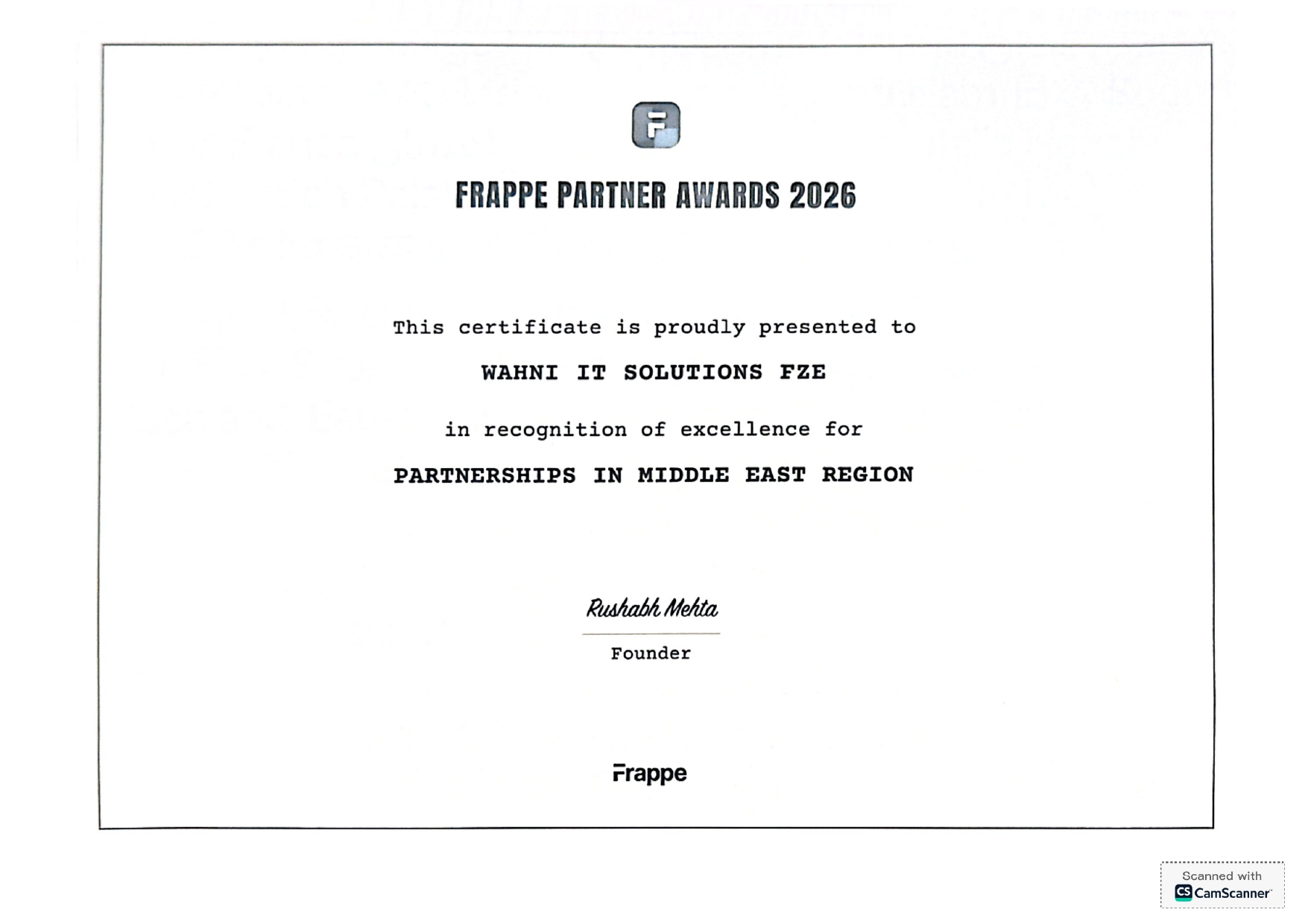
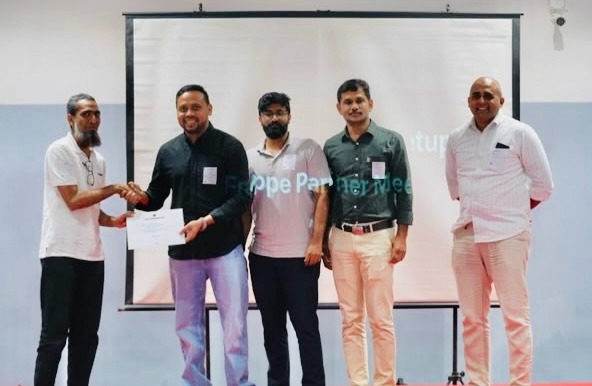
Yes. Wahni IT Solutions has been awarded Best Middle East Partner for 2026 by Frappe Technologies and is the only Gold Partner for Frappe in the UAE. Gold Partner status is awarded to a select group of implementation partners worldwide based on technical capability, project experience, and customer satisfaction, so when you work with Wahni, you're working with a highly trusted ERPNext partner in the UAE.
Wahni IT Solutions has achieved Process Maturity Model Level 5 (PMM 5), the highest level of process maturity recognized within the Frappe partner network. This means our ERPNext implementations follow well-defined, measured, and continuously improving processes at every stage, from requirement gathering through go-live and long-term support, so you get consistent delivery quality regardless of project size.
Yes. Wahni has the highest Frappe/ERPNext customer retention rate among implementation partners in the UAE. The majority of our clients continue with us well after go-live for ongoing support, system enhancements, and additional module rollouts. This reflects the trust built through our end-to-end implementation approach and responsive post-launch support.
Yes. Beyond our published case studies with Fashion Planet, Pogliano BusBar, MK Aluminum & Glass, and Dubai Engineering (DECO), Wahni continues to add new ERPNext success stories across UAE retail, manufacturing, trading, and engineering businesses. Each project follows the same pattern: manual processes replaced with automated, connected workflows, and measurable time and cost savings for the client.
ERPNext Dubai can help businesses bring accounting, sales, purchasing, inventory, CRM, manufacturing, projects, and HR processes into one connected system. Instead of managing information across separate spreadsheets and software, your teams can work from the same real-time business data. Wahni configures ERPNext Dubai based on your business processes, UAE tax requirements, reporting needs, and industry workflows, helping reduce manual work and giving management better visibility across daily operations.
Our ERPNext Dubai implementation services cover the complete process from initial consultation and business requirement analysis through configuration, customization, data migration, user training, testing, and go-live support. We also configure UAE-specific requirements such as VAT, Corporate Tax, WPS payroll, bilingual Arabic-English documents, and e-invoicing where applicable. Wahni works with your team throughout the implementation to make sure ERPNext Dubai is configured around your actual business operations rather than using a one-size-fits-all setup.
Yes. ERPNext Dubai can be configured and customized as your business grows. You can start with the modules and workflows you need today and add additional functionality as your operations expand. Wahni can customize ERPNext for industry-specific processes, approval workflows, reports, integrations, dashboards, and other business requirements. This makes ERPNext Dubai suitable for startups, SMEs, and established UAE businesses that need an ERP system capable of supporting changing operational requirements.